Your Cart (0)

Good fly casting is something that needs to be learnt and refined. This takes practice, and more practice. And it's best to practice away from fish where the focus is totally on what your rod is doing. All fishermen owe it to themselves to be as good a fly caster as they can be and to master the basic art of casting.I'm no casting instructor, but I do get to observe a lot of fishermen and their casting styles. I see the same old problems time and time again. This is how I cast and it works very effectively in our conditions where accurate short to medium distance casts are the norm.
The BeginnerThere are 6 fundamentals of a fly cast
The Basic Fly CastTo increase success rates for sight fishing, being able to consistently cast a short to medium length line, where you are able to consistently lay out a long leader in a straight line on demand, will dramatically increase catch rates, bringing more fish to your net. I find to achieve this you;
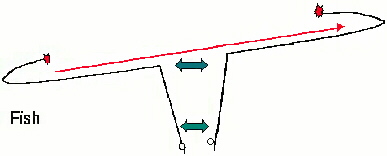
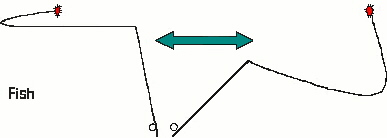
Watch your rod tip next time you're out and see what's going on, also watch your line, pick it up off the water and strongly send it back and up into the sky behind you - keeping it moving in a straight line out behind you, pause, then as you feel the line start to bend your rod tip backward and before it has time to start dropping towards the ground, start your forward cast. An efficient forward cast accelerates the rod smooth through the stroke until the rod reaches the end of the casting stroke where the rod is brought to an abrupt stop. The majority of acceleration takes place near the end of the forward stroke. Ever caught those bushes behind you? Yes well I'm sure we have all spent hours untangling our lines from those dread Matagouri bushes that seem to be following us around at times. Well have another look at the picture above. Note the way the line is angled down on the forward cast and is high up in the air on the back cast. By deliberately sending the line up high into the sky behind you, you'll avoid all those Matagouri bushes. Also this helps you to stop the rod on the back cast at about 12 o'clock. Another positive is it will help in dealing to the wind as out lined lower down the page. This picture shows what you don't want to happen. Simply if the rod tip continues much back past 12 o'clock it's going to start to pull the line downwards and will create a wave action in the line loosing power to your cast. NB This is very common and is caused by using only the wrist to cast. The use of the wrist is minimal in the basic cast. The casting action should involve the whole arm, including the shoulder, with the butt of the rod moving some distance back wards and forwards as you cast. Once you have mastered the basic cast you can then add in all the other types of casts, but the basic cast is the foundation to your continued success. Watch your line and leader as the loop unravels. If the rod is held completely vertical while casting, the loop will also unravel in the same vertical plane allowing the line and leader to roll out in a straight line. If the rod is held out to the side, as many anglers do, the loop unravels on a similar plane as to what the rod is held. This causes the line to tend to curve away in the same direction as it lands. So to cast in a straight line we will be more accurate if the rod is held vertically. If you have ever bowled a cricket ball you'll understand this! We can now use this knowledge to benefit us. We can cast completely straight by holding the rod vertically. If we want the line to curve a little right, angle the rod tip to the right, or to the left to make it curve left. A good way to practice accuracy is to imagine you're throwing a dart. Put your right foot forward if you are right handed, left if left handed. This blocks and steadies the upper body for making short accurate casts. Keep you rod vertical and sight along the rod as though throwing a dart and you'll enjoy watching your line rolling out completely straight. NB You may find when you try this that the rod ends up catching the line when the rod is vertical. I believe you can fix that if you make sure you stop at 12 o'clock on the back cast as outline further up on this page. Fly Casting into the WindTo cope better with the wind you simply need to keep the same timing as the basic cast outlined above, then speed up your action to increase the line speed. This time put your left foot forward if right handed and right foot if left handed (This allows the whole body to become involved giving a longer stroke and more power as in distance casting as it allows you to use the muscles of the torso and legs) If you put your thumb along the top of the grip, by pushing forward and down from the wrist on the forward stroke you can add more power to cut through wind. Make sure you still stop at 12 o'clock on the back cast, otherwise it wont work. It takes some practice but will allow you to handle some quite windy conditions. Important; If you look at the top diagram above notice how the line is angled down on the forward cast. This is extremely important when casting into the wind. You want the line to stop as the power dissipates on the forward cast just above the water, so your fly and line will quickly drop onto the water. This gives the wind less chance of catching it and blowing it back over your head! If it's very windy you can often get away with actually slapping your line down, just make sure it's well upstream of the fish. In contrast look at the second image and imagine how the wind would catch your line if the line was high above the water on the presentation stroke. Tactic: This is pretty obvious, but shortening your leader will make things easier for you. Leader construction is important also. It needs to transmit the power of the cast all the way the fly. Ideally the butt section needs to be of a similar diameter to the fly line then tapering down to your tippet progressively. A lot of the shop brought ones taper to quickly. To over come that you can tie your own or buy heavier ones, say about 7 - 10 lb test and then add sections of tippet to taper it down to what you want. Now I haven't mentioned double hauling and there's a very good reason for this; When I watch the average fishermen trying to cast into the wind, with amusing results as they try everything to get the cast to go, the harder they try the worse things seem to get. They try to double haul thinking that that's the answer, their hands are going this way and that but the line never really gets to where it needs to go. The problem in my opinion is that if you don't have a good basic cast to start with, you'll still struggle to throw a line into any sort of wind. Once that is achieved a double haul will improve performance into the wind by increasing line speed. A fast action rod is essential, use an appropriate weight rod and a good weight forward line. Also you can go up one line weight above that recommended for your rod which is a good idea. Refine your casting in windy conditionsThis one will take a little explaining but it's such a help, so read on. If you're a right hander and the wind is blowing right to left across the direction you are casting into, we encounter the problem of the wind blowing the line into our rod, causing tangles, frustration and sometimes loud expletives. I see many clients attempting to solve this problem in different ways however the cure is really simple; Watch your line as you cast and you'll notice it probably stays mainly to the right side of the rod during the whole of your casting stroke, so when the wind blows from the side it blows the line into the rod. The solution is to let the line travel down the other side of the rod (is the light bulb coming on yet?) so that the wind blows it away from the rod. To do this simply tilt your rod tip left by turning your wrist more and more to the left until the line is passing along the left side of your rod, the rod tip would be traveling somewhere up above your left eye, all of a sudden the wind will be blowing your line away from your rod instead of into it and guess what? no more tangles, frustrations, expletives etc!! It takes practice, the rod doesn't need to be tilted far left, just enough to keep the line going down the left side. You'll feel you lose a little power, if you tilt too far the more power you will lose along with accuracy. I think you'll be pleased with the result, I find it very useful. But again you need to maintain that good basic cast for this to work. |